

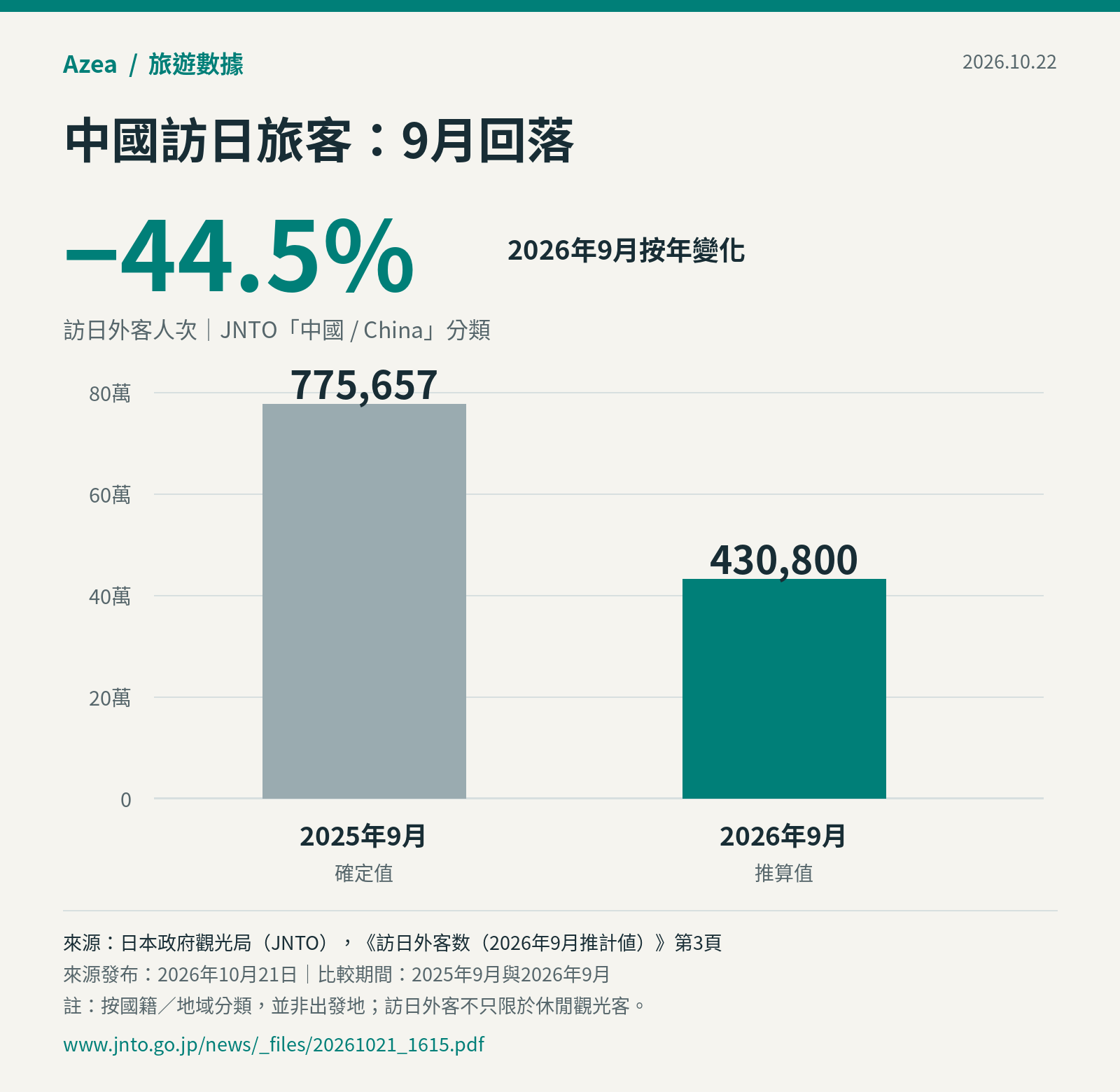
On 21 October 2026, the Japan National Tourism Organization (JNTO) released an estimate of 430,800 visitor arrivals in its “China” category for September 2026. [1]
Compared with 775,657 arrivals in September 2025, that represents a 44.5% year-on-year decline, larger than the 5.0% decline in overall visitor arrivals to Japan over the same period. [1]
Azea interpretation
For Macau, existing August data showing that mainland Chinese visitors accounted for 79.5% of total visitor arrivals highlight the need for the industry to watch changes in its main source market’s travel patterns. The statistics cover different months and cannot establish that visitors who did not go to Japan went to Macau instead. [2]
Sources and data periods
- Japan National Tourism Organization (JNTO): September 2026 visitor arrivals estimate (PDF, page 3)
Source release date: 21 October 2026. Data period: September 2026 versus September 2025. The China row on page 3 reports 775,657, 430,800 and −44.5%; total visitor arrivals were 3,103,700, down 5.0% year on year. JNTO official release page
- Macau Statistics and Census Service: August 2026 visitor arrivals (Government Information Bureau republication)
Source release: 18 September 2026 at 16:00. Data period: August 2026. This is previously released background, not news released on 21 October or a same-month comparison with Japan’s September figures.
Definitions and limits
JNTO’s China category follows nationality/region, not place of departure, and is not directly equivalent to Macau’s mainland Chinese visitor category. Visitor arrivals include qualifying entrants and re-entrants such as expatriates, their families and international students, not only leisure tourists. Permanent residents whose primary residence is Japan and crew members are excluded.
Japan’s September 2026 figure is an estimate; the September 2025 figure is definitive. Year-on-year change = (430,800 ÷ 775,657 − 1) × 100 = −44.4599868%, rounded to −44.5%.
Macau’s mainland Chinese visitor share = 3,561,667 ÷ 4,478,073 × 100 = 79.5357065%, rounded to 79.5%. This share is calculated from official arrival counts, rather than quoted as an official published percentage.
The two datasets cover different months and statistical categories and cannot establish a shift of visitors from Japan to Macau. Azea’s interpretation is editorial analysis, not an official causal conclusion. This article does not attribute the change to politics, exchange rates, flights or other factors.